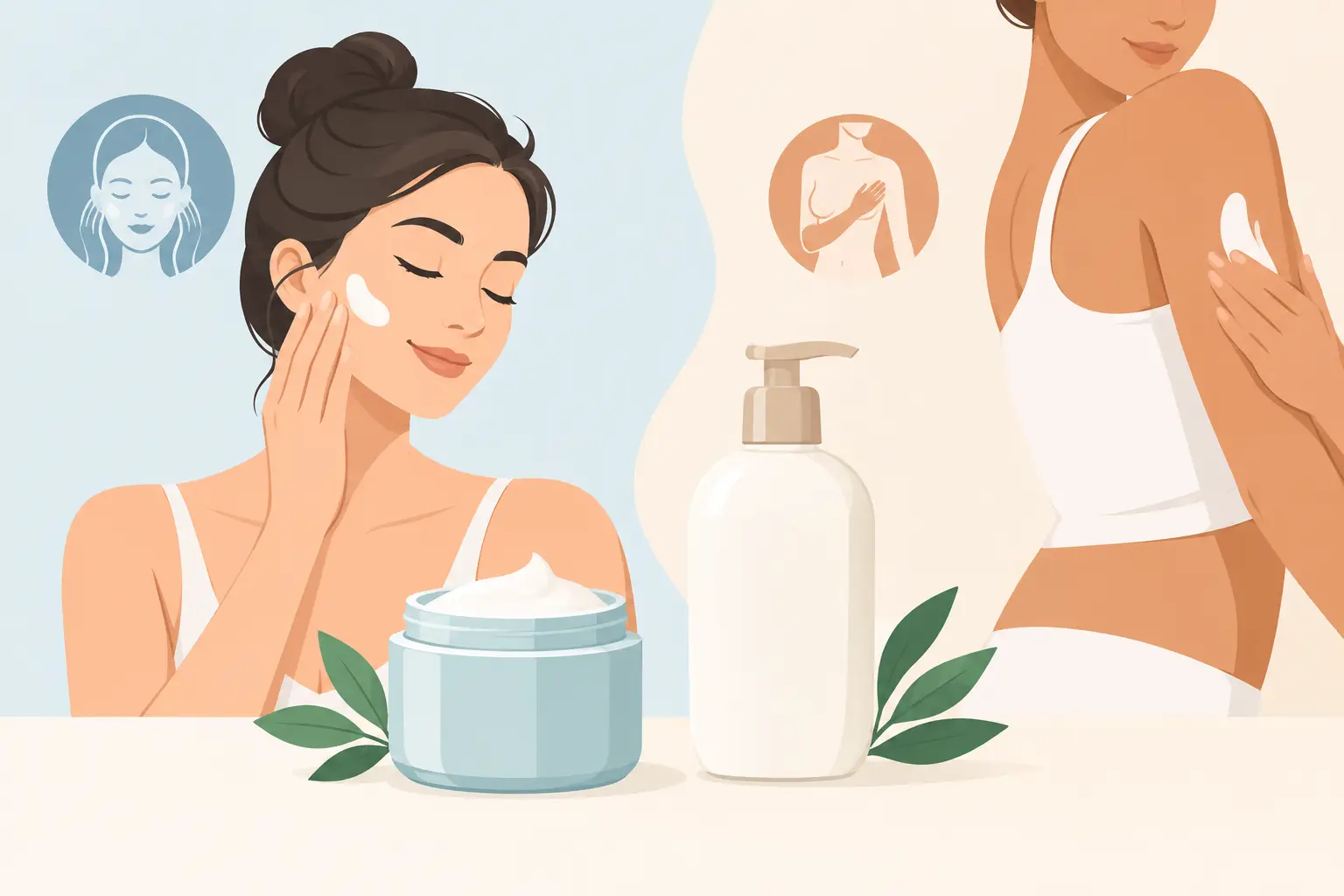
The small decision to use face moisturizer versus body lotion often happens in front of the mirror, when the face is cared for and the hands move downward. The neck, chest, and ears are right there, exposed to the same daylight and changing weather, yet they are often offered whatever product remains.
That is understandable. A body lotion feels practical. A face cream can feel precious. But these formulas are usually designed with different skin, different expectations, and different sensory needs in mind. The most useful answer is not that one category is always superior. It is knowing where each belongs, then giving the skin below the jawline the attention it has quietly been missing.
Face Moisturizer Versus Body Lotion: The Real Difference
Facial moisturizers are generally formulated for skin that may be more prone to visible congestion, sensitivity, oiliness, or reactivity. They often have lighter textures, more refined finishes, and ingredient choices that account for a facial routine involving cleansing, makeup, and daily sun protection. Because facial skin is a central concern for many people, these products also tend to carry a higher price per ounce.
Body lotions are designed for broader coverage. They may be richer, more occlusive, or made to spread quickly across arms, legs, and hands. A well-made body lotion can be exactly what dry body skin needs, especially after bathing. It is not inherently lesser skincare. It is simply made for a different scale of use.
The distinction matters most in the middle ground: the ears, neck, and décolleté. These areas are not the face, but they do not always behave like the skin on the shins or elbows either. They are regularly exposed, often lightly cleansed or overlooked altogether, and subject to frequent movement from turning the head, sleeping, speaking, and everyday life.
Why the Neck and Chest Need Their Own Consideration
The skin of the neck and chest can feel especially vulnerable because it is thin, exposed, and in constant motion. Fragrance-heavy or aggressively active body formulas may be perfectly comfortable on the legs while feeling less welcome here. On the other hand, a small dab of face cream may not feel sufficient when applied from jawline to chest every night.
This is where category labels can become less useful than formulation and habit. A moisturizer for this area should feel comfortable enough to use consistently, substantial enough to support softness, and considered enough for skin that sees the sun, wind, clothing friction, and the passing of time.
The ears deserve the same pause. Their outer skin is exposed whenever hair is worn up or short, and they are easy to miss when applying moisturizer or sunscreen. They also sit at the edge of the facial routine, which is perhaps why they so often receive neither facial care nor body care. A brief, gentle application around the outer ear can turn an omission into a ritual.
Can You Use Body Lotion on Your Face?
Sometimes, yes. If a body lotion is gentle, fragrance-free, and your facial skin tolerates it well, using it once in a while is unlikely to be a problem. Travel, an empty cabinet, or a cold morning does not require perfection.
Still, regular use is where the trade-offs become clearer. Some body lotions are too rich for faces that are prone to clogged pores. Others contain fragrance or a finish that feels uncomfortable beneath sunscreen and makeup. A lotion formulated for the body can also be more than the face needs, particularly if your skin is reactive or you already use facial treatments.
It works in the other direction, too. You can use a face moisturizer on your body, and many people do on hands or small dry patches. The limitation is practical: facial creams are often expensive to use over large areas, and their smaller containers do not encourage generous application after every shower.
Rather than making the face and body compete, let each product do the work it was made to do. Keep the face routine focused. Use body lotion generously where it performs beautifully. Then be more intentional about the places that live between those two categories.
What to Look for in Moisture Below the Jawline
For the ears, neck, and chest, the best texture is personal. Some people prefer a cream that leaves a protective, cushioned finish before bed. Others need something that absorbs readily because they dislike product on their collar or pillowcase. Comfort is not a minor detail. A product you enjoy applying is more likely to become part of the evening.
Look beyond buzzwords and consider purpose. Humectants help draw water toward the skin. Emollients soften and smooth its surface. Occlusive ingredients help slow moisture loss. A thoughtful moisturizer may use a balanced combination, without asking the skin to tolerate a crowded list of trend-driven actives.
If your skin is easily irritated, a simpler formula is often a sensible place to begin. Fragrance can be pleasurable, but it is not required for care. The same is true of a long list of high-intensity ingredients. More steps do not necessarily create a more meaningful practice.
There is also a difference between moisturizing and sun protection. A nightly cream can support the skin's comfort and resilience, but it does not replace broad-spectrum sunscreen during the day. When the neck, chest, and ears are exposed, extending sunscreen to those areas is one of the clearest forms of daily care.
A Nightly Ritual for the Skin You Usually Forget
The best time to care for these areas is often after the face routine, when the day is beginning to quiet. There is no need to create a complicated sequence. After cleansing, apply your facial products as usual. Then take a small amount of moisturizer and warm it between your hands.
Start at the base of the neck and move upward with unhurried strokes. Continue across the décolleté, then lightly over the sides and back of the neck if those areas are exposed or feel dry. Finish by pressing a little product around the outer ears, including behind them. Avoid getting cream inside the ear canal.
This is not about chasing a dramatic change in the mirror. It is about recognizing that these areas carry the same visible life as the face. They meet the weather. They hold tension. They are touched by collars, jewelry, hair, and hands. They deserve care that is neither an afterthought nor an elaborate project.
RĒMĒMBĒR was created around this simple idea: a focused nightly cream and a moment of attention for the ears, neck, and décolleté. Not another crowded step, but a quiet extension of the care you already know how to give.
When to Adjust Your Routine
Season, climate, and skin changes all matter. In dry winter air, the neck and chest may want a richer layer than they do in summer. If you have recently introduced exfoliating or prescription treatments, keeping the surrounding routine gentle can help reduce unnecessary irritation. And if a new product causes persistent stinging, itching, rash, or breakouts, stop using it and speak with a dermatologist or other qualified clinician.
There is no prize for using a face cream everywhere, and no failure in using a body lotion where it suits your skin. The wiser choice is the one that respects the area in front of you. Slow down at the mirror tonight. Breathe. Let your hands travel a little farther than usual, and care for the skin that has been waiting just below the familiar.